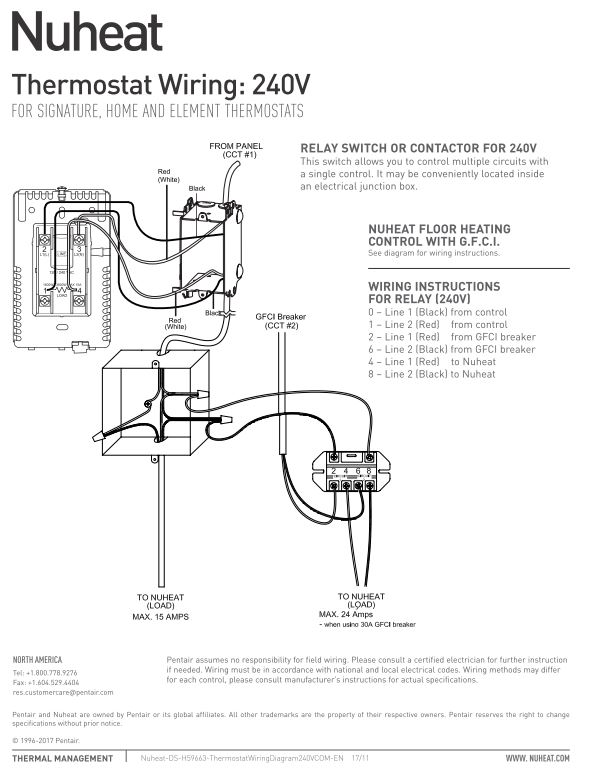
Understanding the Power Architecture of a Schluter Ditra Heat Thermostat Wiring Diagram
The Schluter Ditra Heat system relies on a precise electrical circuit architecture designed to deliver 120V or 240V AC to a resistive heating cable matrix while precisely monitoring floor temperatures through a dedicated sensor probe. Proper execution of the Ditra Heat Thermostat Wiring Diagram ensures that the line-voltage feed, neutral return, and resistive load paths comply strictly with the National Electrical Code, specifically NFPA 70 guidelines regarding dedicated branch circuit sizing and ground-fault circuit-interrupter protection. Because these systems draw significant continuous current depending on the square footage of the mat installation, understanding how the power source feeds the internal relay switch and load terminals is vital for professional electricians and advanced technicians.
💡 Technical Key Takeaways:
- Core Focus: Diagnostic schematic and terminal connection layout for Ditra Heat Thermostat Wiring Diagram.
- Target Scope: Field technicians, automotive DIYers, and residential/commercial electricians.
- Safety Rule: Always disconnect the primary power source/battery terminal and verify zero voltage with a multimeter before touching wires.
Terminal Roles, Conductor Gauges, and Expected Multimeter Readings
Accurate identification of the thermostat connection points requires a systematic breakdown of the rear terminal block. The following matrix outlines the functional pathways, typical conductor sizing, and expected digital multimeter values encountered during routine electrical diagnostic procedures. Related guide: Connection 240V Baseboard Heater To A Circuit Breaker Panel.
| Circuit Path | Typical Gauge / Protection | Multimeter Check |
|---|---|---|
| Line In (L1 / Hot) | 12 AWG or 14 AWG copper, dedicated 15A or 20A breaker | 120V or 240V AC relative to neutral/L2 when closed |
| Line Out (Load / Heating Cable) | 12 AWG or 14 AWG, integrated GFCI protected | Continuity (ohms) matching heating wire specification; voltage matches supply when calling for heat |
| Neutral / L2 | 12 AWG or 14 AWG matching supply feed | 0V reference to ground (on neutral leg) |
| Floor Temperature Sensor (NTC Thermistor) | Low-voltage shielded pair | Variable resistance in kilo-ohms (kΩ) inversely proportional to floor temperature |
Step-by-Step Diagnostic Workflow for Thermostat and Floor Sensor Faults
When troubleshooting a malfunctioning radiant floor heating installation, follow a strict logical sequence to isolate power delivery failures from sensor degradations. Begin with a thorough visual check of the electrical box to verify that terminal screws are properly torqued and that no insulation is pinched under the clamp. Next, utilize a digital multimeter to perform a live voltage check across the line inputs to confirm that branch circuit protection has not tripped. If the unit powers on but fails to output voltage to the heating cable when calling for heat, perform a voltage drop test across the internal relay contacts. When heating anomalies occur alongside error codes, inspect the low-voltage sensor inputs; disconnect the thermistor wires and measure resistance across them, comparing your reading against Schluter resistance charts to determine if the probe embedded in the mortar bed has suffered an open or short circuit. For broader insights into household circuit integrations, review our resources on Home Electrical Wiring Diagrams.
Mitigating Common Installation Hazards and Verifying Circuit Integrity
Working with line-voltage radiant heating systems introduces critical safety concerns that demand strict adherence to NFPA 70 standards. Always verify that the branch circuit is locked out and tagged out at the main electrical panel before manipulating any wiring behind the display fascia. A frequent pitfall during installation involves nicking the heating cable or the low-voltage sensor wire during tiling, which compromises insulation resistance. Technicians should always perform a megohmmeter (insulation resistance) test and a continuity ohm check on the heating cable before and after tile installation to record baseline values. Neglecting these checks can lead to hidden ground faults that trip the built-in Ground Fault Circuit Interrupter prematurely or prevent proper thermal regulation.
Technician and DIY Frequently Asked Questions
What causes the built-in GFCI on the Ditra Heat thermostat to trip repeatedly?
Repeated GFCI tripping usually indicates an insulation breach in the heating cable, moisture trapped within the cold splice connection, or a direct short to ground. You should isolate the heating cable and test its resistance to ground using a high-voltage insulation tester to verify cable integrity.
Can I extend the wire for the floor temperature sensor if it is too short to reach the thermostat?
Yes, you can extend the sensor wire using standard 18-gauge twisted pair thermostat wire, ensuring all splices are securely soldered and insulated. However, keep the splice outside the wall cavity in an accessible junction box if required by local electrical codes, and avoid running the sensor wire parallel to high-voltage lines to prevent electromagnetic interference.
How do I test if the internal relay of the thermostat is failing?
Set your multimeter to measure AC voltage and place your probes across the load output terminals while the thermostat display indicates a call for heat. If the input voltage is correct but the output voltage remains at zero despite a clicking relay sound, the internal switching contacts have welded or failed open, requiring thermostat replacement.
Explore More Electrical Schematics and Diagnostic Resources
Mastering complex temperature control layouts empowers you to diagnose and repair modern electrical systems with complete confidence. Continue expanding your technical expertise by browsing our comprehensive library of professional guides at ReadWires.com, where you can also access related categories like Appliance and Device Wiring and Wiring Troubleshooting.
Wiring Diagram Schematics & Details